Why Primitive Reflexes Matter for Healthy Ageing: What New Research Is Revealing

Updated: Mar 21
Europe is getting older—fast. More than one in five Europeans is already over 65, and by 2050 this number is expected to rise above 30%. But longer lives do not automatically mean healthier lives. Rates of cognitive decline are rising, and dementia—especially Alzheimer’s disease—is becoming an increasing burden for families, healthcare systems, and society.
Our research at the Széchenyi University in Hungary is uncovering new clues about how the operation of the ageing brain changes. One of these is something surprisingly simple: the re-appearance of reflexes we once had as babies.
This article explores why these reflexes matter, what they can reveal about brain health, and how a new test set—the START protocol—may open the door to earlier detection and potentially new approaches to support ageing minds.
What Are Primitive Reflexes?
Every healthy newborn has a set of automatic movements called primitive reflexes. They help babies survive before they have voluntary control of their bodies.
You may recognize some of them:
Grasp reflex – a baby automatically closes their hand around your finger,
Sucking reflex – essential for feeding,
Rooting reflex – turning toward a touch on the cheek, seeking food,
Glabellar tap response – blinking repeatedly when the forehead is tapped,
Babkin reflex – stimulating the palms triggers opening of the mouth.
These reflexes are normal in infancy—but only in infancy.
As children grow, higher brain regions—especially the prefrontal and motor cortex—strengthen and gradually inhibit these early reflexes. This process is guided in part by GABA, a neurotransmitter essential for regulating brain activity and preventing overstimulation.
Over time:
Babies: low GABA → primitive reflexes active,
Adults: high GABA → primitive reflexes inhibited,
Older age: declining GABA → primitive reflexes may re-emerge.
And here is the key point:
When these reflexes come back in adulthood, something is wrong.

Source: Porges, E. C., Jensen, G., Foster, B., Edden, R. A. E., & Puts, N. A. J. (2021). The trajectory of cortical GABA across the lifespan: An individual participant data meta-analysis of edited MRS studies. eLife, 10, e62575. https://doi.org/10.7554/eLife.62575
Why Primitive Reflexes Reappear in Older Adults
The return of primitive reflexes in older adults—sometimes called “frontal release signs”—is not simply a curiosity. It is a sign that the brain’s control systems are slipping.
Re-emerging reflexes are associated with:
reduced activity in the prefrontal and motor cortex,
decreased attention and executive function,
increased risk of falls,
higher anxiety,
neurodegenerative conditions, especially dementia.
The return of primitive reflexes may be an early signal of cognitive decline.
The START Protocol: A Measure of The Presence of Primitive Reflexes
To better understand the presence and effect of primitive reflexes, our lab at the Széchenyi University in Hungary developed a test protocol we call START (Standardized Assessment of Reflex Testing).
Rather than checking only a few reflexes, the START protocol evaluates 18 primitive and transitional reflexes. Beyond frontal signs, it evaluates a broader reflex profile. The test objectively measures the state of cortical inhibition.
What our Research Shows
We administered the START test to two groups in the 60+ age group:
Healthy adults,
Individuals diagnosed with dementia or Alzheimer’s disease.
The findings were clear and statistically strong:
Cognitive scores (MMSE) were dramatically lower in the dementia group,
People with dementia had significantly more persistent primitive reflexes,
More primitive reflexes were strongly linked to worse cognitive performance.
The correlation between the number of primitive reflexes and low MMSE scores was extremely high, meaning primitive reflexes may be a reliable indicator of cortical decline.
This opens up an exciting possibility:
Could inhibiting these reflexes through specific exercises improve cognitive function in individuals affected by dementia?
This is one of the key questions driving the next phase of research.
A new perspective: insights into brain function using fNIRS
The examination of primitive reflexes can shed light on changes in brain functioning, but we also wanted to see what happens in the brain in cases where a reflex from infancy becomes active again.
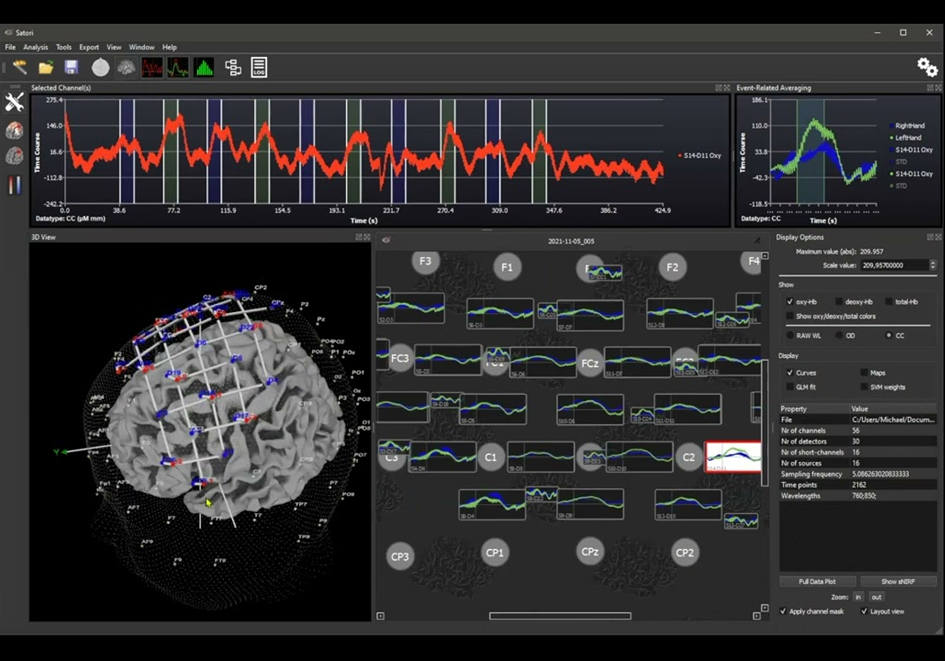
For this purpose, we used a technology called fNIRS (functional near-infrared spectroscopy), which allowed us to observe the motor cortex responsible for movement in real time. We examined the activity of this brain region in older adults and were interested in how the brain area responsible for voluntary grasping movements functions in individuals in whom the infant grasp reflex could be elicited.
What is fNIRS?
fNIRS (functional near-infrared spectroscopy) is a harmless, non-invasive brain imaging method. During the examination, the device emits low-energy light in the near-infrared range through the scalp and skull, which reaches the superficial layers of the cerebral cortex.
fNIRS does not measure the activity of neurons directly; instead, it observes how the oxygen content of the blood changes in a given brain area during a task or activity. When a brain region becomes more active, it requires more oxygen, which leads to increased blood flow to that area—this change is what fNIRS is able to detect.
The method therefore measures the following:
changes in the ratio of oxygenated and deoxygenated blood in the cerebral cortex,
changes in blood flow associated with specific brain regions,
and, based on these measures, it infers which cortical areas are involved in performing a given task.
fNIRS is safe, painless, involves no radiation exposure, and can be used at any age, making it suitable for both children and older adults. During the examination, the participant remains fully awake, and the measurement does not cause discomfort.

Goals of the Study
We aim to:
Map cortical activity in senior citizens who have uninhibited primitive reflexes,
Identify patterns of reduced brain activation in motor and prefrontal regions,
Repeat the fNIRS measurements and other tests after 4 months of reflex-inhibition exercises.
The hope is to determine whether specific reflex integration exercises can:
strengthen cortical networks,
suppress unwanted reflexes,
improve motor and possibly cognitive function,
demonstrate true neuroplasticity—the brain’s ability to reorganize and heal.
Although the study is ongoing, individual observations show signs of measurable cortical change. This suggests the ageing brain may be far more adaptable than once believed.
Why This Matters for Sustainable Health
The concept of sustainable health is not just about living longer—it’s about preserving independence, quality of life, and cognitive vitality.
If primitive reflex testing can:
detect early signs of decline,
track brain health over time,
guide targeted exercises to support neural function,
then we may have a low-cost, non-invasive way to support healthy ageing.
Just as we check blood pressure or cholesterol, primitive reflex testing might one day become a routine part of assessing brain health in later life.
The Bigger Picture: A Second Childhood—But With Opportunity
Primitive reflexes supported us at the start of life.Their return may signal that the brain is entering a vulnerable stage—a “second childhood.”
We can respond proactively to help senior citizens:
through reflex-inhibition exercises
through movement and sensory training
through lifestyle and cognitive engagement
through early detection using tools like START
The return of primitive reflexes should not be seen as a sign of defeat—but as messages from the brain, asking for help and offering a window of opportunity.
What can I do to learn more?
Read my article about Healthy Aging.
Do the reflex integration exercises featured on my Seniors video page.
Read my book Rewiring the Brain to learn all about primitive reflexes.
Below are recent research papers on this topic published by our team at the Széchenyi University.
Research
Járai R, Stephens-Sarlós E, Ihász F, Bulgay C, Balog Á, Horváth-Pápai A, Alföldi Z, Tóth EE, Somogyi A, Podstawski R and Szabo A (2025). Quantifying the relationship between physical performance and mental wellbeing in older adults: a field study. Front. Aging 6:1630343. https://doi.org/10.3389/fragi.2025.1630343
Stephens-Sarlós, E., Horváth-Pápai, A., Tóth, E. E., Ihász, F., Somogyi, A., & Szabo, A. (2025). Relationship between primitive reflexes, functional fitness, handgrip strength, and physical activity in older adults aged 65 and over. Physiological Reports, 13, e70229. https://doi.org/10.14814/phy2.70229
Stephens-Sarlós, E., Toth, E., Ihász, F., Alföldi, Z., Somogyi, A. & Szabo, A. (2024). Changes in primitive reflexes in older adults and their relationship to mental health indices: An experimental investigation. Experimental Gerontology, 196. https://doi.org/10.1016/j.exger.2024.112583


